Coming September 8, 2026

Feed Them Well

A Guide to Raising Healthy, Confident Eaters for Life

Every parent wants to feed their kids well — but between picky eating, battles with sugar, confusing nutrition headlines, and the fear of saying the wrong thing about food or bodies, it’s hard to feel confident about any of it. Feed Them Well, from Kids Eat in Color founder and registered dietitian, Jennifer Anderson, is the definitive guide that gives parents the exact words, scripts, and tools they need to navigate it all from baby’s first foods through the teen years — without judgment, guilt, or perfection required. This is the book that teaches you how to think about feeding your kids, so every decision feels less like a guess and more like a plan.
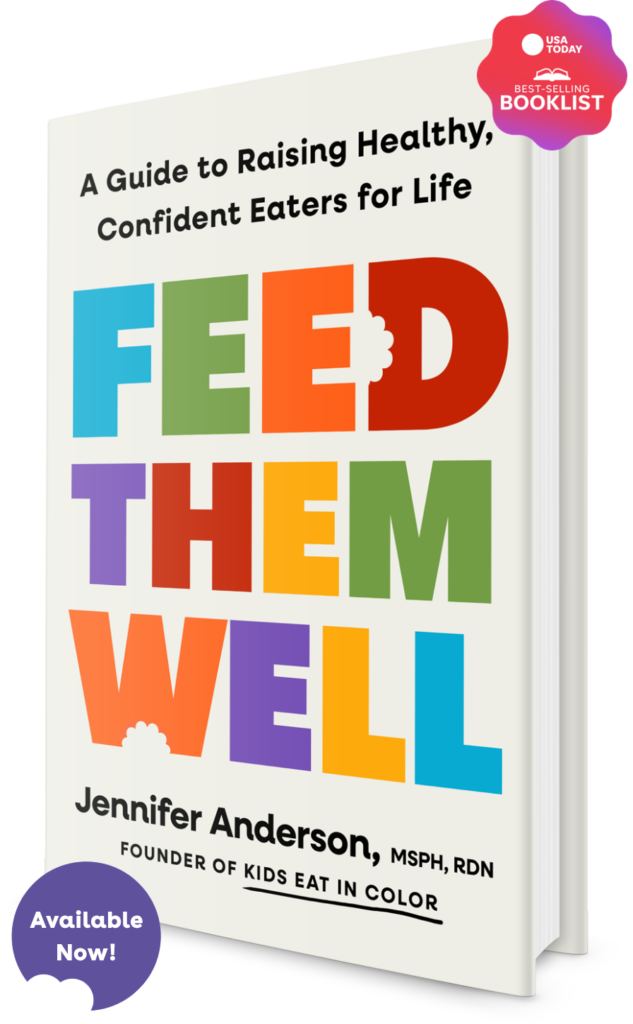
Feed Them Well: A Guide to Raising Healthy, Confident Eaters by Jennifer Anderson, Kids Eat in Color
Feed Them Well Book Amazon Order
Feed Them Well Book Barns & Noble Order
Feed Them Well Book Bookshop Order
Order Feed Them Well at Target
How you raise a healthy confident eater

The book that meets you where you are now, with the answers to all your questions about feeding your child.

Inside You’ll Find

  • The Food Impact Tiers — a framework that ranks what matters most in your child’s nutrition, so you know where to focus when you’re barely keeping it together and what to add when you have the energy to do more.
  • The 5 Questions for Food Headlines — the exact questions to ask every time you see scary news about food, so you can stop spiraling and start deciding.
  • Scripts for the Hardest Conversations — what to say about weight, bodies, sugar, “good” and “bad” foods, and the comments your child brings home from school, with specific language for every age.
  • A 6-Step Process for Feeding Dilemmas — a decision-making method for the situations that don’t have simple answers, from managing relatives to navigating a child obsessed with sweets.
  • A Framework for Raising a Child Who Trusts Their Own Body — how to build confidence that isn’t about size, help them recognize hunger and fullness, and give them a foundation that holds up long after they leave your table.

Pre-Order

Hardcover

Feed Them Well Book Amazon Preorder
Feed Them Well Book Barns & Noble Preorder
Order Feed Them Well at Target

Audio


E-Book

Detailed Description

From Jennifer Anderson—registered dietitian and founder of Kids Eat in Color, trusted by over two million parents—comes the evidence-based guide to feeding children from baby’s first foods through the teen years.

When you became a parent, you probably thought feeding your child would be the easy part. You swore you’d never bribe your kid with dessert, never make a separate meal because it was easier than a standoff, never hear yourself say, “just try it,” in a voice that didn’t sound like your own.

Or maybe feeding was easy for years—until your child came home one day and said, “My friend says bread makes you fat,” and you froze. Maybe your tween started picking at their plate after a pediatrician visit. Maybe your toddler who ate everything suddenly won’t touch anything green. Now what?

Every parent wants to feed their kids well—but between picky eating, battles with sugar, confusing nutrition headlines, and the fear of saying the wrong thing about food or bodies, it’s hard to feel confident about any of it. Now in Feed Them Well, Anderson gives you the exact words, scripts, and tools they need to navigate it all —without judgment, guilt, or perfection required.

You’ll learn how to talk about food without planting the seeds of diet culture. How to handle sugar, snacks, treats, and dessert in a way that actually works—at home, at birthday parties, at Grandma’s house. What to do when your child refuses vegetables or gags on textures. How to navigate weight conversations when doctors, family, or other kids bring it up. And how to cut through nutrition confusion to figure out what truly matters for your family.

This isn’t another recipe book. This is the book that teaches you how to think about feeding your kids, so every decision feels less like a guess and more like a plan.

About the Author

Jennifer Anderson is the founder of Kids Eat in Color, a trusted comprehensive resource for parents supporting their child’s nutrition and relationship with food, with a social media company of over 2 million. She is the CEO of BetterBites, a platform of digital health programs that equips parents with tools to guide their child through nutrition-related diagnoses and challenges. She is a registered dietitian and has a masters of science degree in public health from the Johns Hopkins School of Public Health. She lives in Maryland with her husband and two kids.

Frequently Asked Questions

Child’s Relationship With Food & Their Body

The fact that you’re asking this question means you’re already helping your child’s relationship with food! It’s true that words matter and can play a role in how our kids think about food and their bodies. 

Talking about foods in very simple categories — such as “good/bad” or “healthy/unhealthy” — can make it harder for kids to have a flexible relationship with food. It’s still important, though, for kids to know enough factual information about food to care for their bodies.
To prepare to write Feed Them Well, I extensively studied the research on teaching kids about nutrition and how it affects their relationship with food and their risk of disordered eating. I lay it all out clearly in the book — including:

  • how to teach kids accurate health and nutrition information without planting the seeds of diet culture 
  • the six most impactful messages about food that kids need to know
  • scripts for every age so you always know what to say

Pre-Order your copy here

Weight conversations can be some of the most difficult to navigate — and the most consequential. Research shows that how adults talk to children about their bodies has a direct impact on their relationship with food and their risk of disordered eating. My general recommendation is to avoid commenting on your child’s body shape or size unless they bring it up first.

But the real world doesn’t always cooperate. Doctors mention it at checkups. Grandparents say the wrong thing at the dinner table. A classmate says something cruel on the playground. And sometimes your child comes to you directly with questions or worries about their own body.

Feed Them Well has a dedicated chapter on body image and disordered eating, with specific scripts for talking to your child about weight — whatever their body size — so you have the words when you need them. It also includes a model for how to approach these tough conversations — because the how is often just as important as the what – and red flags that signal your child needs more support from professionals.

Pre-Order Feed Them Well

This is one of the most common places parents get stuck — because we all want to teach our kids about nutrition, but the “good food/bad food” framework can backfire in ways that aren’t always obvious. 

Feed Them Well takes an in-depth look at “healthy/unhealthy” thinking about food: what the real risks are, and which “risks” you may have heard that are overblown (or simply made up). It also helps you understand why flexible thinking about food matters and how two-category thinking can sometimes work against us. 

If you use healthy/unhealthy language, you won’t find a guilt trip here — just new information to consider and practical tools if you decide to try a different approach.

Those practical tools include the six important food messages kids need to hear, plus age-specific nutrition information and scripts — lots of them. Including scripts for the moments that catch you off guard, like:

  • Your child asks if a dessert is healthy.
  • Someone called your child’s food “unhealthy,” “poison,” or “toxic”.
  • You’re serving a new food and don’t know what to say.
  • Their school had a lesson labeling foods as healthy or unhealthy.
  • You won’t buy a food they’re asking for and want to explain why.
  • Your child wants to talk about sweets or snacks.
  • You want to explain what a specific food does for their body, or how it might support their health.

Whatever comes up at your table, you’ll have the words ready.

Pre-Order Feed Them Well

Nutrition & Handling Dessert

Here’s something that surprised me after reading hundreds of studies on this topic as I prepared to write this book: research around child food restriction may be the most widely misrepresented research of any area of child feeding. And in Feed Them Well, I set out to fix that.

Should you give your child unlimited cookies? Stop them at two? Keep cookies in the house? Avoid cookies altogether? 

I cover all of it — including what we actually do and don’t know about restricting kids from hyperpalatable foods (sweet and salty foods) according to research studies, whether intuitive eating is the right strategy for children, when kids should be introduced to sweets, and how to observe your child to know what they need. 

I also introduce a new framework called Structured Permission that gives you a confident way to decide what to offer your child and how, protecting both their health and relationship with food.

And if your child is obsessed with sweets or snacks or sneaking food? There’s a dedicated chapter for that too. 

Pre-Order Feed Them Well Here

Most kids get plenty of protein, but in Feed Them Well I help you know the amount your child needs so you never have to wonder. And while protein dominates the headlines, fiber is probably the nutrient that most deserves more attention. That’s part of why I created the Health Impact Tiers — to make sure parents are thinking through all the nutrition variables that could affect their child’s health, whether they’re making headlines or not. 

The Tiers tell you which nutrients and foods have the broadest impact, so you know what to prioritize. For example, if your child is getting plenty of calcium but only half the calories they need, that’s a much bigger concern. On the other hand, once the big things are covered, a parent might decide to intentionally increase the variety in their child’s diet beyond basic recommendations to optimize their child’s gut health.
When it comes to supplements and multivitamins, not every child needs them, but some do. Feed Them Well covers whether supplements are essential for all kids, how to tell if your child actually needs one, and how to choose supplements that are safe if you decide to use them.

Pre-Order the Book

Picky Eating & Mealtime Madness

You’re not alone! When kids stop eating vegetables, the first instinct is usually to push for three more bites or bribe them with dessert. Sometimes those strategies work — but sometimes they just lead to more battles.

My first recommendation is to stop battling altogether. High-pressure mealtimes often make picky eating worse, especially when a child is refusing vegetables across the board. Focusing on connection and giving pressure a break can sometimes turn things around on its own.

That’s not the whole story, though. Once you stop pressuring, mealtimes may become more pleasant — but that doesn’t necessarily mean your child will start eating foods they dislike. The next step is a parenting strategy that gives kids space to learn without feeling pressured, while also helping prepare their bodies to accept new foods. 

In Feed Them Well, I lay out those strategies in detail, including how to create meaningful family meals, with dedicated chapters on both picky eating and extreme picky eating so you have specific, actionable steps you can start using right away.

Pre-order now

Feed Them Well has a dedicated chapter on the mealtime madness that every parent experiences at one point or another. It’s packed with specific strategies you can try right away — for food throwing, staying at the table, food battles, kids who complain or refuse to come to dinner, teaching manners, and age-appropriate utensil use. I’ve been there too, and these are strategies that work with real kids.

Pre-Order Now

Yes — and the shift is often smaller than you think. A lot of the battle around new foods comes from pressure, even when it’s well-intentioned. When kids feel like they’re being watched and evaluated, they dig in. When food feels like play, they’re far more likely to engage.

Feed Them Well includes practical, do-tonight ideas for making new food exploration low-stakes and enjoyable — for your child and for you. Because the goal isn’t to get them to eat the food tonight. It’s to help them feel comfortable enough around new foods that eating them eventually feels natural.

For tonight, try a taste test. Put out a few versions of the same food — different dips, varieties, seasonings, or preparations (we love different colored bell peppers) — and do a fun, upbeat demo comparing them yourself. Don’t push your child to participate; just invite them. With toddlers and preschoolers, ramp up the silliness. With older kids or tweens, close your eyes, have them hand you each version one at a time, and try to guess which is which. Keep the focus on the fun, not the food.

Pre-order Feed Them Well Now

If you’d like to know more about your child’s eating, you can take the PSA-Eat. I developed this screener with a team of pediatric healthcare specialists to help parents assess their child’s eating — so you can stop wondering and feel confident about your next step. 

If you think your child may be experiencing a medical problem related to their eating, please contact their healthcare provider right away.

Take the screener

Health Information & Nutrition Headlines

The headlines make it hard to know what actually matters — what will have the biggest impact on your child’s health, and what makes for a great headline but doesn’t play much of a role in their day-to-day wellbeing. Feed Them Well gives you the tools to figure that out for your own family. 

For example, if you’re curious about whether your child is affected by food dyes, I give you a protocol to test whether their behavior is actually impacted – so you can find out for yourself rather than wondering and worrying every time a new headline appears. 

And rather than offering a one-size-fits-all rule on ultra-processed food, I provide in-depth information about hyperpalatable foods — those foods with added sugar, fat, or salt that tend to be more heavily processed. 

Understanding these foods matters because they affect your child’s ability to respond to their own hunger and fullness cues, as well as their overall nutrition and health. I help you understand how hyperpalatable foods factor into whether we should set limits with kids, what the ramifications are for their relationship with food, and how to reduce kids’ exposure to these foods without them knowing.

For everything else landing in your feed, I give you the 5 Questions for Food Headlines — a framework for deciding whether a nutrition claim is actually relevant to your family and whether it’s worth your attention or not.

Feed Them Well gives you what you need to navigate nutrition news without an anxiety spiral.

Pre-order Here

This is one of the most overwhelming parts of feeding kids today. The nutrition information landscape is genuinely chaotic, and a lot of it is designed with clicks — not your child’s health — in mind.

Feed Them Well gives you three tools to cut through it. The Health Impact Tiers rank aspects of nutrition by how broad their impact is on your child’s health, so you always know what to focus on first. 

Additionally, the 5 Questions for Food Headlines help you decide whether any nutrition claim is actually relevant to your family and worth acting on. And a practical guide to verifying information that teaches you how to evaluate whether a source is credible and how to tell when someone is only giving you part of the story.

Together, these tools help you identify what’s noise — and focus on what actually supports your child’s health.

Pre-Order Feed Them Well Here

ARFID, Extreme Picky Eating, & Neurodivergence

Often, food refusal based on texture is due to a child’s difficulty processing sensory input. It can feel genuinely uncomfortable or produce real anxiety — either of which can make kids adamantly refuse certain foods.

Feed Them Well provides a wealth of information for helping picky eaters expand what they’ll eat, as well as building a healthy relationship with food. It’s also a great companion to any food-related therapy your child is participating in. The book alone, however, doesn’t provide the in-depth therapeutic programming that my new app-based BetterBites® program was designed to do.

If you’d like more information on whether your child’s eating is typical or more extreme, you can take the PSA-Eat. This screener is a tool I designed with a team of pediatric healthcare specialists to help parents understand their child’s eating.

The Pediatric Screener for ARFID and Extreme Picky Eating is a tool I designed with a team of pediatric healthcare specialists. It allows you to see whether your child has indicators or risk factors associated with ARFID. It does not diagnose ARFID. ARFID can only be diagnosed by a trained healthcare provider.

If you already know your child has ARFID or extreme picky eating and are looking for a treatment solution, Feed Them Well won’t directly address that goal — although it does include a chapter on ARFID and extreme picky eating, and the book as a whole will still help you support your child’s nutrition and relationship with food and their body throughout their eating struggles.

For ARFID or extreme picky eating treatment, a better option is BetterBites® for ARFID and Extreme Picky Eating — a new app-based program I designed for families looking to improve their child’s eating, nutrition, and psychological health.

While Feed Them Well doesn’t have a chapter specifically on neurodivergence, the entire book is built around how to individualize feeding for your child. This is especially valuable for neurodivergent kids who don’t respond to one-size-fits-all advice. Neurodivergence is also addressed directly in the chapter on ARFID and extreme picky eating.

If your child has ARFID or extreme picky eating and you are specifically looking for a treatment solution, the BetterBites® for ARFID and Extreme Picky Eating program is a new app-based program I designed for families looking to improve their child’s eating, nutrition, and psychological health. You can find out more about whether your child has indicators for ARFID or extreme picky eating with the PSA-Eat.

Book Table of Contents & How The Book is Different From Social Media

Both — and that’s intentional. Feed Them Well gives you the big picture of how to raise a child who has a healthy, confident relationship with food, in a world full of diet culture, food marketing, and concerning nutrition headlines. It gives you the tools to navigate all of it – like the steps needed to navigate food dilemmas, The Health Impact Tiers that help you decide what nutrition to actually focus on, and a method for having tough conversations about bodies and weight.

It also troubleshoots the specific hard moments: the sugar battles, the vegetable standoffs, the weight comment a classmate made, the mealtime chaos that makes you want to give up and order pizza. Every chapter is built around the real questions I hear from parents, with practical scripts and strategies you can use right away. Whether you’re just starting solids or navigating a 14-year-old who is feeling pressured to be thinner, this book meets you where you are.

Pre-Order your copy here.

Here is the table of contents:

Introduction

Part I: The Five Pillars of Eating with Embodied Independence
1: Feed with Curiosity
2: Eat with Embodied Independence
3: Eat Together
4: Eat Without Judgment
5: Eat What Nourishes Us

Part II: A Six-Step Plan for Navigating Food Dilemmas
6: Navigating Real-Life Dilemmas with Confidence
7: Feeding Disagreements: When Family Members, Loved Ones, and Friends Feed Differently
8: Starting the Eating Journey
9: Mealtime Madness, from Table Manners to Food Battles
10: Typical Picky Eating
11: Extreme Picky Eating and ARFID
12: When a Child Is Obsessed with Sweets, Can’t Stop Eating Hyperpalatable Foods, or Is Sneaking Food
13: Concerns About Body Image and Disordered Eating
14: Health Diagnoses and Therapeutic Diets

Conclusion

Pre-Order Your Copy Now

Social media and the other resources give you a great starting point — but for years I’ve been holding back on many topics because social media doesn’t give me the space to go deep and provide important nuance. This book is where I finally could.

Feed Them Well is the complete system behind everything you’ve seen on KIEC — the full why behind the what, with tools and frameworks I created specifically for this book that don’t exist anywhere else. Things like: 

  • The Health Impact Tiers, 
  • The 5 Questions for Food Headlines, 
  • More scripts for the hardest conversations about weight and bodies
  • A step-by-step process for navigating the feeding dilemmas that don’t have simple answers
  • The most important six messages kids need to know about food

I’ve also changed some of my recommendations after doing extensive research to write the book — so there’s genuinely new thinking and strategies here, not just a collection of what’s free on social (I wouldn’t want to buy that and I wouldn’t expect you to either!)

Think of social media as the trailer. This is the movie. 

Pre-order your copy here

About the Book: Age-range, Recipes, Length, Audio Book, Pre-orders

Yes! Feed Them Well covers feeding from first foods through the tween and teen years. There’s a chapter dedicated to navigating the feeding journey, as well as mealtime madness with toddlers and preschoolers, picky eating, and complicated dilemmas that can arise in the tween and teen years such as health diagnoses, obsessions with sweets, disordered eating, and more.

This book provides the pillars of feeding that we can work toward throughout our entire parenting journey, as well as the specific strategies needed in different life stages. You’ll be able to return to this book again and again no matter what feeding challenges pop up for your child.
Pre-order Feed Them Well

Feed Them Well is a philosophy and approach book – it gives you the framework for how to feed your child, not what to cook. It’s the foundation that everything else builds on.

If you’re looking for meal plans, I have two – Real Easy Weekdays (focused on variety and exposure) and Affordable Flavors (focused on cost saving). They include a meal system for breakfast, lunch, dinner, and two snacks, and recipes as well. I created Real Easy Weekdays for my family and it’s what we use day-to-day!

If you’re looking for recipes, Everyday Lunches (over 120+ ideas and recipes for lunches) and Everyday Snacks (toddler and kid snacks) are popular ebooks!

You can get Real Easy Weekdays, Everyday Lunches, and Everyday Snacks in the Real Easy Mealtime Bundle to save.

Pre-Order Feed Them Well

Yes, there is an audio book.

It’s 384 pages including thorough endnotes and an index.

It is reading-only, not a workbook.

Pre-order Feed Them Well Audio Book

Yes, there will be pre-order bonuses! I’m working on them, so if there’s a specific bonus idea that you have, feel free to send it to me hello@kidseatincolor.com. Make sure you get my Small Bites newsletter – I’ll announce pre-order bonuses there as well as on social media as soon as I have them put together!

You can buy Feed Them Well from your favorite book seller – I am equally supported no matter where you purchase!

Pre-order Now

Related Articles